I’m Martin Clemons, an electrical engineer who’s passionate about electronics, aviation, and developing practical technology that solves hard problems.
I’m told my most unusual skill is taking deeply technical projects and explaining them to non-technical people in a way that conveys not just what’s being done but also why.
I believe that this skill is rooted in my multifaceted background, including a Master of Engineering in power electronics and embedded systems from the University of Colorado Boulder, and years as a commercial pilot and aircraft mechanic, flying turboprops in the Rocky Mountains and restoring vintage aircraft.

Through my company Peak Data LLC, I enjoy building one-on-one relationships with my clients, first by learning about their business’s challenges, and then developing technology together to solve those problems piece by piece.
Since 2010 I have been the hardware and software engineer behind a handful of long-running products, from accessibility survey instruments to industrial signal conditioners, usually from the first schematic through production and the years of support that follow.
I work remotely from my home lab, speak fluent English, German and Czech, and have worked with both US- and EU-based clients. I would be delighted to hear about the challenges you’re working on, so please contact me and let’s talk!
Education and certificates
- Master of Engineering, Electrical Engineering, power electronics and embedded systems. University of Colorado Boulder, 2013. 4.0 GPA.
- Bachelor of Science, Aviation Technology. Metropolitan State College of Denver, 2002.
- FAA Commercial Pilot, single and multi-engine land, instrument airplane, glider.
- FAA Flight Instructor (2001-2023).
- FAA Airframe and Powerplant Mechanic with Inspection Authorization.
- DHV Sport Pilot, single and tandem paraglider.
Current and past projects
Industrial sensors with a secure firmware platform
2019 to present. I designed the PCB hardware and firmware of a signal conditioning module with both digital and analog interfaces, then built the product’s software platform around it, including:
- A secure bootloader backed by a hardware authentication chip, with cryptographically signed and verified firmware updates and configuration changes, including a complete wire protocol specification.
- An installer-free, browser-based configuration app utilizing WebUSB and WebSerial to communicate with the device.
- A firmware catalog server and the signing and production-provisioning tools that tie it together with the configuration app and the product.
- An architecture-level assessment of the platform against the EU Cyber Resilience Act and the BSI TR-03183 technical guideline.
Field survey instruments for accessible trails and sidewalks
2010 to present. I designed and prototyped a suite of wired and wireless sensors for surveying trails and pedestrian routes against accessibility standards, wrote their firmware, and supported series production. I developed two generations of sensor hardware consisting of:
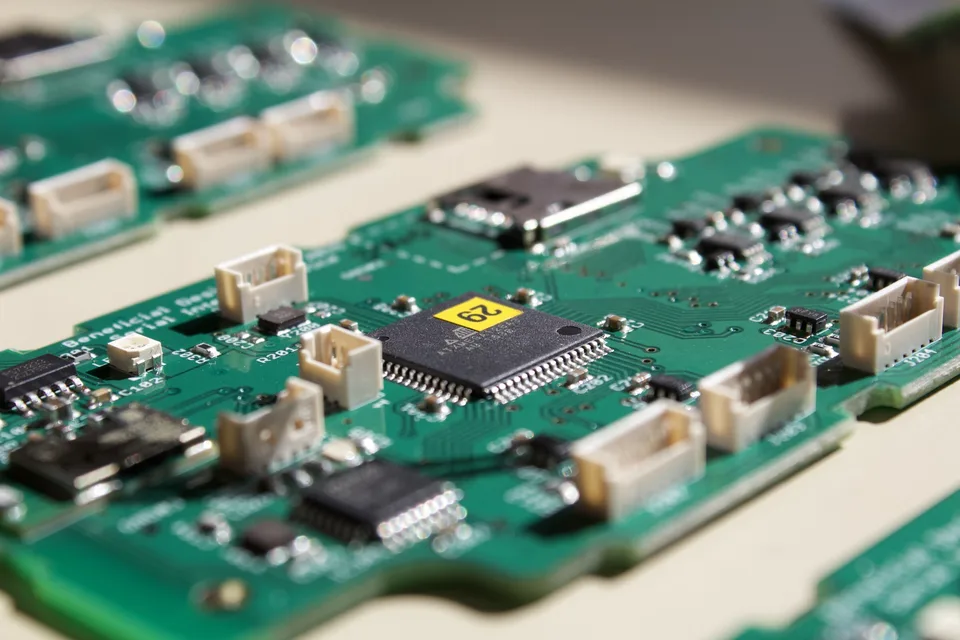
- Wireless slope, distance and height sensors with a handheld display unit, including gyroscope-stabilized and Kalman-filtered grade and cross-slope measurement with 0.1% accuracy and repeatability.
- Low-power wired sensors including a hall-effect quadrature wheel encoder, a precision tilt sensor with USB interface, and a GPS module carrier.
- A programmable, multi-protocol, multi-channel USB interface (Bluetooth, Zigbee, serial) which replaced a legacy USB-1208FS device.
In 2025 I revisited this project and replaced my client’s legacy Python and C# PC applications with an offline-first progressive web app. This new app captures survey data on a tablet, interfaces with sensors using WebUSB, and exports ArcGIS-ready bundles.
A tablet computer for grandparents
2016 to 2017. I supported a startup developing a customized Android tablet for seniors by leading the electronics design of their first prototypes, then the design of the power management and voltage regulation of their pre-production prototypes. My responsibilities included:
- The voltage regulation and power sequencing of the various tablet components including the SOM (system-on-module), display, touchscreen, sensors, USB, and internal cameras.
- Optimization of converter efficiencies in the power-on and standby states while maintaining target BOM cost.
- A battery module with fuel gauge and protection based on the TI BQ28Z610.
- A charger design around USB-C Power Delivery based on the TI BQ25703.
- Battery selection and sourcing for a design intended for volume production.
An online shop and publishing platform
2014 to 2021. A Django application built end to end for a small business, including product catalog, cart and Stripe checkout, affiliate program, shipping management, video courses, podcast publishing and email newsletter, deployed with Ansible and nginx.
Other selected experience
- Engineering intern at Siemens Drive Technologies in Berlin, 2008: generator design for offshore wind turbines.
- FAR Part 121 airline first officer flying the SA-227 Metroliner, flight instructor, and commercial pilot conducting aerial photography for mapping.
- FAA certified aircraft mechanic performing general aviation maintenance including aircraft restoration, engine repairs, electrical system repairs, and avionics installation.
- 4500+ flight hours in single-engine, multi-engine and turboprop aircraft.
- Teaching aircraft maintenance refresher courses covering topics such as ADS-B and electrical system maintenance and troubleshooting.
- Management and operation of a private airport in Montana.
Areas of expertise
Hardware
- Schematic capture and PCB layout, developing and maintaining accurate component libraries.
- Low noise layout techniques for mixed-signal PCBs, switching converters, and high speed signal lines such as MIPI CSI/DSI and USB.
- Power electronics including battery chargers and management, USB-C Power Delivery, DC-DC converters, low-power design for battery-operated devices.
- General microcontroller design, prototyping, testing, and troubleshooting procedures.
- Sensors and interfaces: MEMS inertial sensors, encoders, GPS modules, Zigbee and Bluetooth modules, USB, industrial DACs.
- Installation, repair, and inspection of aircraft electrical systems in accordance with AC 43.13-1B and manufacturers’ instructions.
- Prototype and small-run assembly with surface mount and through hole components.
Embedded C
Starting from bare-bones libc I’ve developed:
- Device drivers & HALs.
- Software architecture utilizing DMA and event system to meet real-time deadlines.
- Real-time cooperative schedulers.
- Event-driven USB device stacks including standard and custom class devices.
- An object-style LCD widget library (bitmaps, text, shapes, softkeys and selectors) with row-streamed rendering over DMA to conserve SRAM.
- Secure bootloader utilizing hardware authentication ICs with HMAC-SHA256 signing.
- Serial protocols for modules including Zigbee, GPS, and custom sensors.
- Digital converter control on 8-bit MCUs: flyback, full-bridge, sine inverter, solar peak-power tracking, and a two-stage converter with supercapacitor storage.
- A Linux BMS testbed: real-time sampling of LTC6804 cell monitors over isoSPI using POSIX real-time scheduling with rate-monotonic priorities, including scheduling analysis, measured verification, and basic SOC estimation.
- WebSerial and WebUSB compatible devices featuring no-install “plug and play” connectivity through a web browser and web app.
Software and infrastructure
- Python, including building basic tools & utilities through to complete Django driven web backends.
- Nim, for both native programs and browser apps compiled to JavaScript.
- Elixir, JavaScript, HTML and Sass.
- Linux servers: Ansible, nginx, Caddy, PostgreSQL, Docker, Terraform, Syncthing.
- Documentation: protocol and hardware specifications, architecture overviews, regulatory gap analyses (EU Cyber Resilience Act, BSI TR-03183), and hardware manuals.